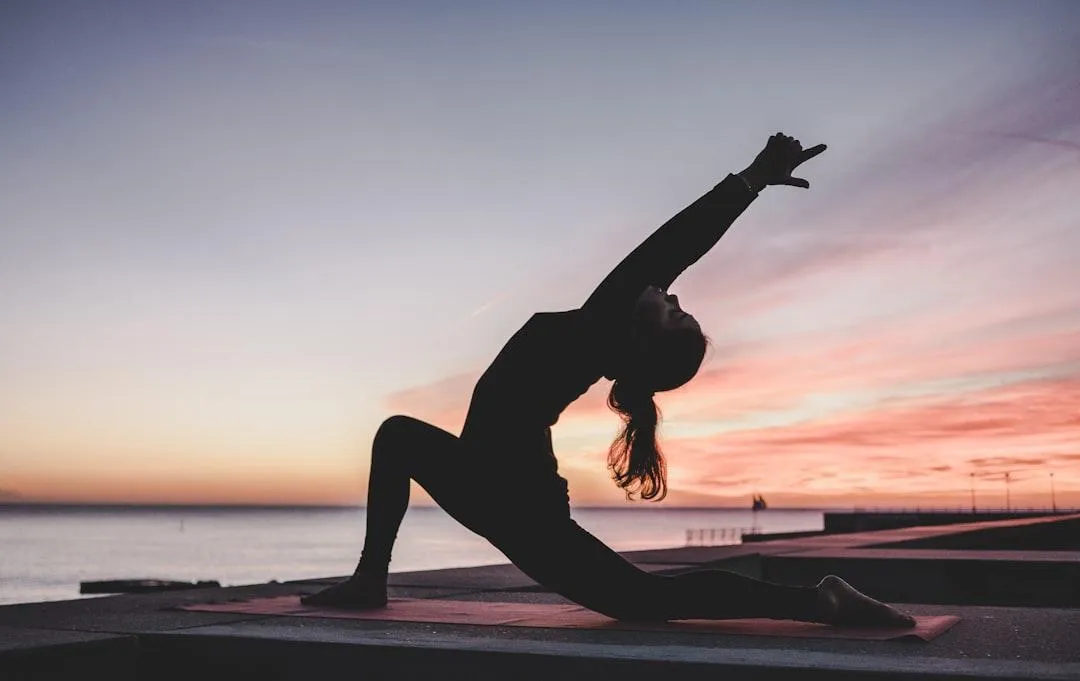
What a Yoga Pose Taught me about Self Trust
What a Yoga Pose Revealed About Self-Trust and My Nervous System
Dr. McClain Sampson, Hear Me Roar Coaching
Every Saturday morning, I go to an hour-long warm yoga class. It’s less about fitness and more about grounding myself and reconnecting with my body. For me, yoga has become a weekly ritual of emotional awareness and nervous system regulation—a place where I can slow down, listen inward, and reconnect with the embodied wisdom that often gets drowned out by the pace of daily life. On this Saturday, my intention was simple: to remain open to my own wisdom. Not intellectual analysis, not productivity insight, but the quieter form of knowing that comes from practicing self-trust and honoring inner authority. The kind of wisdom that surfaces when we stop overriding our bodies long enough to notice what is actually happening inside us. That intention ended up revealing more than I expected. During class we were invited to attempt Bird of Paradise, a yoga pose that looks graceful and serene when someone else does it but feels like a clumsy hot mess when I try it. If you’ve never seen the pose, imagine standing on one leg while your torso folds forward and both arms wrap around your bent leg in a bind. From there you slowly begin to stand up, lifting the bound leg with you until eventually that leg extends outward and upward while the standing leg stays rooted to the ground. The final shape looks almost like a human exclamation point—one leg grounded, the other reaching outward in a long diagonal line while your torso rises tall and open. It’s elegant in theory, but in practice it’s a delicate negotiation between strength, balance, and trust in your own body. I had attempted the pose before but had never pushed myself past the wobbly middle stage, the moment where everything feels unstable and you’re not quite sure whether you’re about to succeed or topple over. But this time something shifted. I rose up slowly, felt my balance begin to stabilize, and then extended the leg. For about three seconds I held the full expression of the pose before my nervous system panicked, my arms quickly untangled, and I plonked back onto my mat. Immediately afterward the instructor invited us to sit quietly and notice what was happening in our bodies after the challenge. My heart rate was elevated, which made sense given the exertion, but what surprised me was the sudden wave of fear and panic moving through my chest. The sensation felt disproportionate to what had just happened. I hadn’t fallen. Nothing hurt. Nothing was actually wrong. And yet my body was responding as if something threatening had occurred. As I sat there breathing, a memory surfaced from when I was eight years old in gymnastics class. I remembered running toward the pommel horse, launching my body into the air, and feeling an incredible sense of strength and freedom as I soared. And then suddenly—BAM—I landed flat on my back and the wind was completely knocked out of me. If you’ve ever had that experience, you know the feeling. Your body goes into shock. You can’t breathe. You can’t move. Everything stops while your system tries to recalibrate. Sitting on my yoga mat decades later, that childhood memory suddenly connected to the panic I had just felt. What my body remembered wasn’t simply the fall; it remembered the sequence. First there was the feeling of power, freedom, and momentum, and then came the abrupt smack that took the breath out of my body and left me temporarily helpless. That moment in gymnastics wasn’t the whole story of my life, of course, but it became a powerful metaphor for a pattern many of us experience in personal growth and leadership. I want something deeply, I move toward it with my whole heart, I feel energized and alive in the pursuit, and then somewhere in the middle things get hard, uncertain, or unstable. That is often the moment when the mind begins whispering questions: Is this worth it? What if I fail? What if the struggle means I’m not capable? And without realizing it, I sometimes stop right in the middle of the process. The hardest part of Bird of Paradise wasn’t actually the pose itself; it was the unstable middle stage where my body had not yet found its balance. That moment of wobble is where many people abandon the effort—not because they lack the ability, but because uncertainty activates the nervous system so quickly. In the world of personal development and emotional resilience, this is where our patterns of self-doubt and self-abandonment often appear. The mind tries to protect us by encouraging retreat before the metaphorical “smack” can happen. The insight that morning was simple but powerful: my nervous system can panic within seconds when faced with uncertainty, even when there is no real danger present. That realization matters because awareness creates choice. When I feel that surge of fear, doubt, or urgency to quit something meaningful, it may not be wisdom telling me to stop. It may simply be my nervous system responding to unfamiliar territory. Practicing Savage Self-Care means learning to notice these reactions without immediately obeying them. Instead of forcing myself to push harder or abandoning the effort entirely, I can pause, breathe, and allow my body to recalibrate. Often what we interpret as a sign to quit is actually the moment when our nervous system is learning how to adapt to growth. If we give ourselves even a few extra breaths, we may discover we are capable of holding the pose—or the dream, the boundary, the relationship, or the new identity—longer than we believed possible. True self-trust isn’t built at the beginning of a journey when everything feels exciting, nor is it built at the end when the result is visible. Self-trust is forged in the unstable middle where uncertainty lives and courage quietly asks us to stay present a little longer. As I rolled up my mat that morning, I realized yoga had given me an unexpected piece of insight about my own patterns. My system reacts quickly to uncertainty, but now I can recognize that reaction instead of letting it dictate my choices. When I feel that surge of panic or doubt in the middle of pursuing something meaningful, I can ask a different question: Is this actually dangerous, or is this simply the moment before my body learns something new? Because sometimes the only thing standing between us and the life we truly want is the willingness to stay in the pose a few seconds longer and trust the wisdom already living inside us.
If This Resonated With You…
Many high-functioning women know exactly what they should do, yet still feel the moment of hesitation when uncertainty appears. Building self-trust isn’t about forcing confidence or eliminating fear. It’s about learning how to stay emotionally present with yourself when things feel uncertain.
This is the heart of my Savage Self-Care framework—developing emotional awareness, honoring your nervous system, and strengthening the inner authority that allows you to make decisions without abandoning yourself.
If you're ready to deepen your self-trust and create a life led by your own values rather than fear, head over to my website and take the Free Inner Authority Assessment and explore my coaching and resources at Hear Me Roar.
